

The dignity of the dead: death toll, denial, and the war in Ukraine


|
|
We need ways of measuring the scale of war: numbers that put images and testimonies into context, and convey the depth of horror. We need figures for deaths and injuries, the share of civilian casualties, the square kilometres of cities reduced to rubble, and the types and numbers of buildings destroyed. Why are schools, hospitals and churches being bombed? Why are children being killed or starved? When does malnutrition become famine?
We also need a framework for interpreting what these numbers mean: when does a war crime occur? When is it a crime against humanity? And when does it cross the line into ethnic cleansing and genocide?
Disinformation around the invasion of Ukraine long predates 2022. Consider the tragedy of Flight MH17 in 2014, for example. Russia tried to blame Ukraine, but it was only a Dutch court ruling that established the Kremlin's responsibility for downing the plane. And then there were Russia’s "humanitarian convoys", used to facilitate the delivery of military supplies under the pretext of helping civilians "trapped in the conflict", even during ceasefires. Since the February 2022 full-scale invasion, we have witnessed incidents such as the theatre massacre in Mariupol, which Russia blamed on Ukraine, the claims that bodies in Bucha were moving, and accusations of staged hospital attacks, to name but a few.
However, there is a more insidious element linked to uncertainty and concealment, which prevents an accurate count of the dead and wounded and makes it impossible to verify images. Let’s start with a case bordering on denialism, all the more revealing because it comes from Alessandro Barbero, one of Italy’s most famous historians.
Alessandro Barbero and the civilians “spared” by Putin
Last October, historian Alessandro Barbero appeared on an episode of the Senza Filt-ri podcast. During the episode, which focused on war, Barbero argued that, despite having nuclear weapons, Russia has no intention of doing to Ukraine what the United States did to Japan during World War II. This is partly because the Kremlin wants to limit the damage, particularly to civilians.
There is clearly no intention to annihilate Ukraine as a country or to destroy its people, even in terms of civilian casualties. When a Russian missile hits a civilian building in Kharkiv and kills civilians, that is clearly not the intention, otherwise Russia would be waging this war very differently. So, contrary to what propaganda and the media say, we have a very strange, low-intensity war in which casualties are relatively low. Of course, it is clear that casualties have accumulated over three years.
This is not the first time Barbero has expressed this view. For example, he did so at an event in 2024 with journalist Marco Travaglio:
Putin's rhetoric about not being able to wipe out what he calls a "brotherly people" is also relevant here, given that he claims to be liberating them from the Nazis. This is certainly the war with the lowest ratio of civilian deaths to military deaths among contemporary wars. According to the UN, there have been around 12,000 civilian deaths, but this figure is probably double that.
In short, true inhumanity must be sought elsewhere: in the United States during World War II, for example, or in Israel today. "I wouldn't call what's happening in Gaza a war at this point," says Barbero. However, in the case of Ukraine, Barbero’s acknowledgement of the death toll is, at most, a reluctant concession. This idea lowers the threshold of moral and political alarm, as well as responsibilities under international law.
As early as 2022, the OSCE described the destruction caused by Russia as "unacceptable". We must also consider the executions of civilians, the mass graves, rapes (including of children), display of beheadings, filtration camps and the hunting of civilians with drones. While this is by no means an exhaustive list, it illustrates the variety and quantity of authoritative sources available to historians, including numerous first-hand accounts.
Barbero neither disputes nor reinterprets these sources; he simply ignores them, without ever being asked to account for this. He also ignores the impact that defensive systems have in reducing casualties. If someone shoots at me and a bulletproof vest saves my life, the shooter's intention does not change just because I am not dead; only the outcome of that intention changes. For Barbero, this elementary logic does not apply.
However, Barbero is right about one thing in the many speeches he has given on the invasion of Ukraine in recent years: the difficulty of obtaining accurate information, particularly regarding the number of casualties, is one of the problems of war.
The fog of war also obscures the figures
There is one victory over Ukraine that the Kremlin can boast: the creation of uncertainty. This uncertainty surrounds the causes of the war and the nature of the aggression, but above all, it surrounds the number and identity of the victims. This uncertainty fuels plausible deniability, a veritable extension of the fog of war, which is not unique to Ukraine. There is no need for an official version when information chaos makes the truth impossible to establish, and journalistic errors get mixed up with propaganda.
This is why journalists are always targeted on the front lines of war. During the war in Gaza, a record number of journalists were killed by the Israeli army to prevent crimes from being documented. In fact, a special Israeli unit was even tasked with gathering evidence to justify the killings. In Sudan, journalists face persecution, famine and sexual violence.
But in Gaza, Hamas's Ministry of Health has managed to provide reliable figures (which are even on the low side, according to The Lancet). Even Israel, for example, acknowledges a civilian casualty rate of 83%. Despite countless difficulties, attempts at delegitimisation and even killings, humanitarian organisations, doctors and aid workers have also been present.
On the other hand, there is no comparable humanitarian presence in occupied Ukrainian territories. As if that were not enough, the Russian Red Cross itself has been accused of actively supporting the Kremlin. However, Putin is not the first to manipulate data: Stalin's famine in Ukraine (the Holodomor) is a prime example of this. Those who occupy a territory aim to control its memory.
For Ukraine, this strategy has resulted in a wholesale reversal of cause and effect and a shifting of responsibility, distorting how the conflict is understood. A prime example of this is the accusation of "genocide" and "ethnic cleansing" that Russia claims Kyiv committed in Donbas. This has been refuted by the Council of Europe, the United Nations High Commissioner for Human Rights, the OSCE, and the International Court of Justice, as the case proceeds.
Then there are the stories about "14,000 people killed by Ukrainians". Of those 14,000, about 10,000 were soldiers. Today, this figure supports an even more insidious argument. It conveys the idea that Ukraine is killing its own civilians, framing the conflict as fratricide. These 14,000 deaths are weaponised to sound comparable to the civilian deaths attributed to the Russian invasion.
As early as May 2022, the UN High Commissioner for Human Rights explained that the figures on civilian casualties were necessarily incomplete:
Actual figures are likely considerably higher as our figures only refer to those cases that we have been able to verify. In areas of intense hostilities – notably, Mariupol – it has been difficult for my staff to gain access and obtain and corroborate information.
Subsequent UN reports continue to record the deaths of thousands of civilians and tens of thousands more injured, but stress that the actual numbers are “probably higher”, mainly due to access restrictions in occupied or still-bombarded areas.
Mariupol: a large-scale massacre impossible to quantify
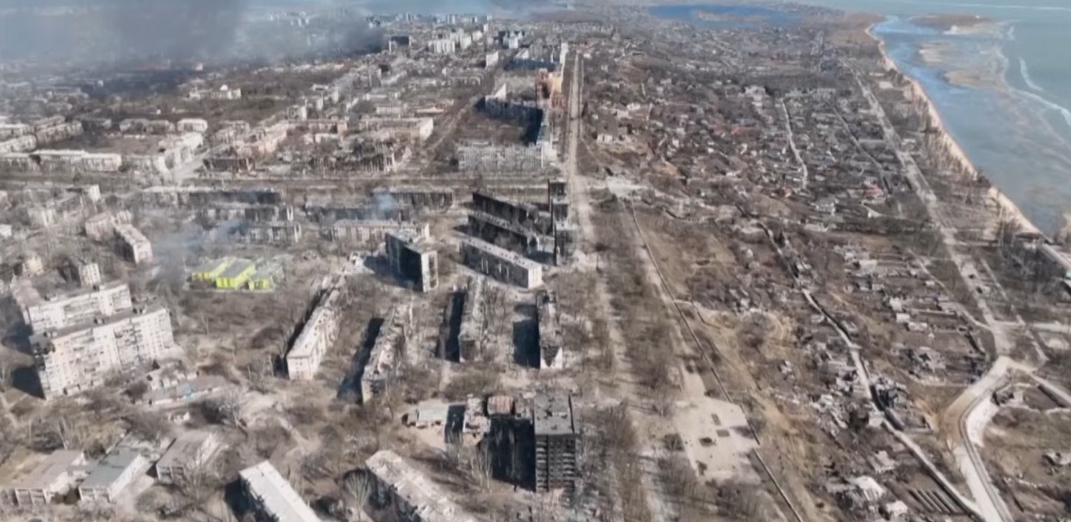
To understand what it means to lose count of the dead, just look at Mariupol, the port city that was besieged and devastated in the early months of the invasion. In February 2022, the city had a population of over 400,000. After months of siege, the Russian armed forces razed it to the ground. This should have made it clear that the defence of a “Russian minority” could not be the cause of the conflict's escalation.
Instead, partly due to the difficulty of obtaining accurate information, we immediately saw a narrative emerge in which war crimes and crimes against humanity were either denied or attributed to the victims. Then, once the siege was over, we even saw a mural attributing the devastation to NATO. This undermined the work of Mstyslav Chernov, Evgeniy Maloletka, Vasilisa Stepanenko and Lori Hinnant, the authors behind 20 Days in Mariupol, who were the only international journalists to remain in the city and cover the siege.
About two years later, Human Rights Watch, together with SITU Research and Truth Hounds, published Our City Was Gone, a report on the destruction of Mariupol.
Researchers examined satellite images, photographs and videos of five cemeteries (Starokrymske, Vynohradne, Novotroitskoye, Manhush and Pavlov Street) and counted the new individual graves and trench-type graves, which were tens of metres long and marked with small wooden plaques. These were then compared with peacetime mortality rates.
Based on this analysis, the report estimates that at least 10,284 people were buried in these five cemeteries alone in the first year of the war, compared to an average of 2,250 deaths in peacetime, indicating at least 8,034 excess deaths. However, it is not possible to take into account those who were cremated, those buried in makeshift graves, bodies not recovered, or multiple bodies buried in a single grave. As for civilian targets:
By mid-May 2022, 93 per cent of the 477 multi-story apartment buildings in the central part of the city had been damaged. All 19 hospital campuses city-wide were damaged, and 86 of the 89 educational facilities that we identified across the city were also damaged.
The Uppsala Conflict Data Program gives much higher figures:
27,000 fatalities are identified bodies, while the UCDP high estimate, which comes from Mariupol morgues, is 88,000. The overwhelming majority are likely to have been civilians.
According to these estimates, the ratio of civilian to military deaths in the 2022 siege is among the highest in the last 30 years, second only to the 1994 genocide in Rwanda.
A similar argument was made in 2023 by the think tank Re:Russia, which goes so far as to make direct comparisons: “even considering only the confirmed number of victims in Ukraine, the devastating number of civilian casualties makes it clear that this conflict resembles the exceptionally brutal war in Syria much more than the Balkan wars.” This reminds us that, outside Mariupol and over the course of months, devastation and massacres of civilians have been the norm.
The genocidal nature of the invasion: forced assimilation
The fact that public debate focuses on figures that cannot be verified, or on comparing the number of deaths in different theatres of war, obscures the genocidal nature of the Kremlin's agenda for Ukraine. Forced assimilation, carried out through measures such as being forced to take Russian passports or the deportation of tens of thousands of Ukrainian children, is in fact the core of Putin's project. For Putin, Ukraine simply "does not exist".
Once again, we only have estimates based on reports of disappearances or censuses of empty orphanages, among other sources. It is said that the figure is around 20,000, but it should be noted that the Russian authorities themselves admitted in 2023 that they had 700,000 Ukrainian children in Russia. These same authorities refused to cooperate with the OSCE on a report dedicated to this phenomenon, yet subsequently created a website with a catalogue of Ukrainian children available for adoption.
The poor quality of Italian media coverage of Ukraine stems from the disproportion between the extensive coverage of the war and the underrepresentation of this specific crime. This ranges from Alessandro Orsini's claim that a child is better off under a dictatorship than under bombs, to the idea that Zelensky is convincing Ukrainians to fight by conjuring up the spectre of "ogres who eat children." Imagine an audience of Ukrainian parents deprived of their children listening to speeches of this kind.
The latest reports speak of at least 165 re-education camps, with the complicity of Belarus. In recent days, Kateryna Rashevska, a legal expert at the Regional Centre for Human Rights, presented evidence to the US Congress that Ukrainian children were being deported to North Korea, testifying to how deeply rooted the Asian country's involvement has become.
We have witnessed endless discussions and debates about peace with the enemy, read articles about Europe being sidelined in the negotiations, and so on, while Trump, in the name of "business as usual", was in practice trying to impose a surrender to please Putin. Amidst all this, few authoritative voices have pointed out that the return of minors should be on the table in any peace negotiations worthy of the name. This is also because assimilation finds its ideal conclusion in the forced enlistment of Ukrainians in the occupied territories, sent as cannon fodder against their compatriots. In the first-hand accounts collected by NGOs such as Human Rights Watch, estimates run into the hundreds of thousands, according to Le Monde.
If numbers are needed to understand, those we are reporting or omitting for Ukraine speak of a widespread abandonment of any desire to understand the "deep roots" of the conflict. Without this basic recognition, it is impossible to reconstruct a truth to be preserved in the collective memory, and without this grounding, every injustice becomes plausible. A society that weaponises the dead for ideological battles and denies—to itself or others—the possibility of mourning will never know peace, justice, or revolution, only endless collective traumas that will shape its identity for an unknowable length of time.
(Illustration: YouTube)